I know what some of you are thinking. More sci-fi? Well, sort of. The Tripods Attack is actually more than just sci-fi.
This book is the first in the Young Chesterton Chronicles series, featuring G.K. Chesterton as a youth in an alternate universe; alternate meaning instead of electricity, everything is run by steam, the Civil War in the U.S. ended up with the Confederate states splitting, Texas became its own republic, and California is its own country. Actually two. There's other smaller stuff, but that's the gist of it.
The Tripods Attack stands out though mostly because of its characters, who are a mix of real life people (like G.K. Chesterton, H.G. Wells, C.S. Lewis, and even J.R.R. Tolkien!!) and fictional characters (like Father Brown, Doctor Watson, and another girl who I really want to mention but can't because that would be a major spoiler; let's just say she lives on Prince Edward Island). And I think that Margaret Sanger is in there, but I'm not sure, her last name is never actually mentioned.
So as you can see, its a pretty mixed cast, and that's what makes it really fun! The author was able to keep the identities of the fictional characters and I think it was fun to see what the younger versions of some of my favorite authors might've been like. It was also cool to see the authors interact with their characters.
The book was very exciting, and I love how the author was able to get Chesterton into several debates on different subjects and bring in themes from some of Chesterton's books. And as for the sci-fi part, I was a little afraid that the sci-fi would clash with the classic characters, but McNichol was able to bring the two elements together in a way that worked really well.
I highly recommend this book, especially for young teens who like sci-fi and the classic authors.
Monday, April 6, 2015
Monday, February 16, 2015
A Cat in Paris
My younger sister saw this movie while she was at a friend's house, and she badgered all of us until we watched it. I have to say, I understand her enthusiasm now. I thought this was going to be a cutesy movie about a girl and her cat, but it wasn't!
'A Cat in Paris' is about a cat named Dino (pronounced dee-no) who leads a double life: during the day he lives with a mute little girl whose father was recently killed; at night he is the partner-in-crime of a burglar. The little girl gets mixed up with some gangsters and it's up to the cat and Niko (nee-ko), the burglar, to save her.
This movie is really cool, even though it's a pretty simple concept there's a lot of drama throughout. I really like Niko the thief, he kind of seemed like a Robin Hood, he was so sweet to Zoe, the little girl. The movie never gives any background on Niko, so it makes you wonder why he was stealing, but in the end he stops stealing. Zoe was really cute too, even though she doesn't really talk until the end, you still get a good sense of her character. Kudos to the animators!
Speaking of animators, the animation in this movie is interesting. It reminded me of the animation for those animated versions of books? The animation looked really cool though. You know how when someone moves really smoothly people say they're fluid? Well when someone was sneaking around (especially Niko) they looked literally fluid. I thought it was really cool.
The soundtrack for this movie was really neat too. It was a mix of that creepy adventure music, plus French music, and an American sounding song that I don't know the name to :P
This movie was a real treat to watch, the plot was engaging, and the characters had depth! I totally recommend this movie, especially as a family movie night. It's not too scary that the littles can't watch it, but it's not too boring and little-kiddish that the older people can't watch it.
I look forward to watching this one again soon!
'A Cat in Paris' is about a cat named Dino (pronounced dee-no) who leads a double life: during the day he lives with a mute little girl whose father was recently killed; at night he is the partner-in-crime of a burglar. The little girl gets mixed up with some gangsters and it's up to the cat and Niko (nee-ko), the burglar, to save her.This movie is really cool, even though it's a pretty simple concept there's a lot of drama throughout. I really like Niko the thief, he kind of seemed like a Robin Hood, he was so sweet to Zoe, the little girl. The movie never gives any background on Niko, so it makes you wonder why he was stealing, but in the end he stops stealing. Zoe was really cute too, even though she doesn't really talk until the end, you still get a good sense of her character. Kudos to the animators!
Speaking of animators, the animation in this movie is interesting. It reminded me of the animation for those animated versions of books? The animation looked really cool though. You know how when someone moves really smoothly people say they're fluid? Well when someone was sneaking around (especially Niko) they looked literally fluid. I thought it was really cool.
The soundtrack for this movie was really neat too. It was a mix of that creepy adventure music, plus French music, and an American sounding song that I don't know the name to :P
This movie was a real treat to watch, the plot was engaging, and the characters had depth! I totally recommend this movie, especially as a family movie night. It's not too scary that the littles can't watch it, but it's not too boring and little-kiddish that the older people can't watch it.
I look forward to watching this one again soon!
Friday, January 30, 2015
Odd Thomas
Ack!! I've been working on this review for a month now, and I'm finally putting it up, I can't believe it's been this long!!
I got 'Odd Thomas' for Christmas, and I was going to save it for a new reading list, but I was so excited by what Monica at Spilled Ink and my Grandmother (who's so hip and up-to-date that she reads novels like Odd Thomas) have been saying about the Odd Thomas books that I told myself I would just read the first couple of chapters and that's it. Yeah. Well, that did NOT go as planned.
I couldn't put the book down!!
Odd Thomas felt fast paced, but it really wasn't. To put it into perspective, the book is 500 pages, and the book covers a time span of 48 hours.
Yeah.
Even though Koontz takes 500 pages to cover a 2 day timespan, the book doesn't feel slow at all. The book feels super fast-paced, and you'll find yourself saying 'Just one more chapter!' and then 10 chapters later, 'I should probably stop now.'
I really like most of the characters in this book. Odd is just so sweet, and I love his attitude towards everyone and everything. I like how he calls people he respects 'Sir' or 'Ma'am' even if he is really close to them, like Ozzie. My view on Stormy Llewllyn, Odd's 'best girl' as he calls her, is kind of mixed. At the beginning I just really didn't like her, she was sooo sarcastic, and I thought sometimes she was bit mean to Odd. Towards the end she grew on me more, and I was able to really see something in her relationship with Odd. She still isn't my favorite character in the book, but my appreciation of her character has grown.
One thing I really love about this book is the Catholic element. It's really awesome to see that an author can write a book with Catholic elements, and the book (and the author) can still be a success! Of course, the book isn't a Catholicism-in-your-face type of book, and the good points with the Catholicism are very much balanced out by all the ugliness that Odd Thomas encounters throughout his adventures.
A word of warning, this book contains some mature content, a LOT of scary, gross, guy-dead-in-the-bathtub moments, and some language. Definitely don't let a 10-year-old read this.
All things considered, this is an awesome book, you need to acquire it now if you don't already have it. It will keep you on edge the whole time, and it has quite a few twists and turns along the way.
Thursday, January 15, 2015
The Hobbit: Battle of the Five Armies
I recently saw the last part of 'The Hobbit'!!!!!! Hooray!! I remember three years ago finding out that not only was Peter Jackson going to be so mean as to make the Hobbit into three parts, but the last part was going to be released in 2014!!! I remember thinking, What?!?!?? I can't wait that long!!! Three years is so far away!!
But it's here!!! It's here!! The moment we've been waiting for is here!!!! And I have to say, the wait was worth it.
A while ago Monica and I of Spilled Ink wrote a post on her blog with a list of items that had to be included/excluded from this, the third Hobbit movie. And, surprisingly, almost every single one of those bossy demands were met! Many spoilers ahead!! Gandalf wasn't rescued by the Eagles, Kili does die, Bard does kill the dragon, Beorn comes in at the Battle of Five Armies, Thorin dies as well, there were only 5 armies at the battle (even though they kind of screwed up who the armies were, but there were only 5), Gollum doesn't make an appearance, and Peter Jackson apologizes for everything he screwed up in the past!
Actually, I made that last one up. End Spoilers.
But if Peter Jackson had expressed his deepest apologies and said that he hoped this movie made up for what he did with 'The Desolation of Smaug', then I would be satisfied. That's how awesome this movie is. It almost makes up for the second Hobbit movie.
I haven't really been reviewing the movie, have I? I guess I've just been gushing and gushing.
But there's so much to gush about. I really like how Thorin was slowly going crazy (not trusting the other dwarves, becoming obsessed with finding the Arkenstone, etc.), and how that was linked to the 'sickness that lies on all dragon hoards'.
Okay, enough gushing.
I liked how they embellished on the White council driving Sauron out of Dol Guldur. Except for one part, which I'll mention in a second. In the book Gandalf barely mentions it to Bilbo. The movie was very true to the book. I know some people don't really like the side story with Azog, but in the movie it's used as an opportunity to include some legends of Middle Earth that aren't well known.
There really wasn't much about this movie that I didn't like. The one thing that really bugged me, was when Gandalf gets rescued by Saruman, Elrond, and Galadriel, and Galadriel uses her power as an elf and a wielder of one of the elven rings to fight off Sauron, and she turns into like, this evil-looking sorceress lady, kind of like in the scene with the Mirror of Galadriel in the Lord of the Rings? I'm not sure how I feel about that. I mean, why do they portray her like that? I can almost get the scene with the Mirror (that's what she would become anyways if she had the One Ring), but not this instance.
I highly recommend this movie, for lack of better words, let me just say that it was awesome :)
But it's here!!! It's here!! The moment we've been waiting for is here!!!! And I have to say, the wait was worth it. A while ago Monica and I of Spilled Ink wrote a post on her blog with a list of items that had to be included/excluded from this, the third Hobbit movie. And, surprisingly, almost every single one of those bossy demands were met! Many spoilers ahead!! Gandalf wasn't rescued by the Eagles, Kili does die, Bard does kill the dragon, Beorn comes in at the Battle of Five Armies, Thorin dies as well, there were only 5 armies at the battle (even though they kind of screwed up who the armies were, but there were only 5), Gollum doesn't make an appearance, and Peter Jackson apologizes for everything he screwed up in the past!
Actually, I made that last one up. End Spoilers.
But if Peter Jackson had expressed his deepest apologies and said that he hoped this movie made up for what he did with 'The Desolation of Smaug', then I would be satisfied. That's how awesome this movie is. It almost makes up for the second Hobbit movie.
I haven't really been reviewing the movie, have I? I guess I've just been gushing and gushing.
But there's so much to gush about. I really like how Thorin was slowly going crazy (not trusting the other dwarves, becoming obsessed with finding the Arkenstone, etc.), and how that was linked to the 'sickness that lies on all dragon hoards'.
Okay, enough gushing.
I liked how they embellished on the White council driving Sauron out of Dol Guldur. Except for one part, which I'll mention in a second. In the book Gandalf barely mentions it to Bilbo. The movie was very true to the book. I know some people don't really like the side story with Azog, but in the movie it's used as an opportunity to include some legends of Middle Earth that aren't well known.
There really wasn't much about this movie that I didn't like. The one thing that really bugged me, was when Gandalf gets rescued by Saruman, Elrond, and Galadriel, and Galadriel uses her power as an elf and a wielder of one of the elven rings to fight off Sauron, and she turns into like, this evil-looking sorceress lady, kind of like in the scene with the Mirror of Galadriel in the Lord of the Rings? I'm not sure how I feel about that. I mean, why do they portray her like that? I can almost get the scene with the Mirror (that's what she would become anyways if she had the One Ring), but not this instance.
I highly recommend this movie, for lack of better words, let me just say that it was awesome :)
Thursday, December 18, 2014
Youtube Channel and Video!
So after more than half a year, I finally posted another video on my channel! Yay!
Ta-da!
Also check out my channel and the rest of the New Catholic Generation Videos!
Ta-da!
The Divergent Series
I've been a bit into dystopian fiction lately, and I recently received this series for my birthday. Now I've read that book on my Chocolate Book list that falls under Milk Chocolate!
And since lately I've had time issues anyways, I decided to review this as a series instead of book by book. Also, uh, I tore through the books so fast (that's three 500 page books in little more than a week. Yeah.....) that I kind of have trouble remembering where one book ends and the next book begins. Like, did Tris know her Mom was Dauntless during or after 'Divergent'?
Anyways, let's get to it!
Oh, yeah, I should probably do a quick plot summary.
The Divergent books are set in (guess what?) the future in a wrecked Chicago. Society is divided into five factions which are supposed to keep the city peaceful. Children grow up in the factions of their parents and when they are 16 they go through an aptitude test which is supposed to help them decide which faction to enter. The main character is Tris Prior, who leaves her Abnegation faction for the Dauntless. She discovers from her aptitude test that she is Divergent, which is, she is told, very dangerous, and she must keep it a secret. During Dauntless initiation she meets fellow Divergent Four, or Tobias. They discover that the Erudite are planning to destroy the Abnegation faction, and then it's all down-hill from there.
I have to say, these are very fast-paced books. Even though each book is around 500 pages long, the author doesn't ramble. Which gives you an idea of just how much happens in these books. The books are in the first person, which normally means you get a lot of reminiscences, but you don't get any of that. Which completely fits with Tris' personality. She's not the kind of dreamy eyed, rambling girl. The last one swaps back and forth between the first-person perspectives of Tris and her boyfriend Tobias, which really confused me at first because I didn't realize that whenever the perspective swaps, a new chapter starts at the same time and under the chapter number it tells you whose perspective it is. Silly me :P
As for the characters, the characters were good, but not crazy uber good. Tris was a very interesting character with a good story arc. She starts out almost like a little girl at first, but during initiation she matures a lot. During most of the second book she seesaws between trying to fight the Erudite and being depressed about all the horrors she's seen (and done). By the end of the book she's gotten through the initial rough patches (with the help of her boyfriend of course), and her story ends with a very bittersweet, heroic ending. And although sometimes I'm sarcastic about her having a boyfriend and how that's so typical of most modern heroines, Tris' relationship with Tobias is different from most modern boy/girl relationships. They protect each other, and Tris is definitely not entirely dependent on him. There are some times when Tris totally ignores Tobias' advice and what he asks her to do. Tris makes a lot of hard choices, and while she's definitely not perfect, she does the best that she can in the tough spots she gets stuck in.
Tobias, the other main character, is also interesting, but not quite as complicated as Tris. He has abusive parent issues that plague him and make him constantly question his self-worth. Tris helps him to see that he is not worthless, which is another reason that their relationship is different from other guy/gal relationships: It's not just that Tris depends on Tobias; Tobias depends on Tris too. They lean on each other for support. Tobias was uber protective of Tris during 'Insurgent', but Tris got it through his head that she really didn't need or want protecting. Oh, and I forgot, his nickname is Four, but I call him Tobias, because, well, that's what Tris does most of the time.
None of the other characters are really relevant enough to talk about here, maybe I'll do a post with some thoughts on them another time.
But what about the villain?
Okay, so if you've only read the first book, stop reading this post, because it contains mucha spoilers.
In the last book you find out that several generations ago after several wars the U.S. government tried to eliminate all the bad aspects of human nature by removing certain people's genetic tendencies towards a certain trait: i.e., removing the gene for cowardice, or aggressiveness, or, well, you get the idea. The only problem that the government didn't foresee was that if you removed one genetic tendency, you also removed another and brought out an even worse one. The people who didn't have a genetic tendency towards cowardice for example, also lost their sympathy and became ruthless. Anyone who had been genetically altered like this was labeled Genetically Damaged. Their memories were reset and they were placed in 'experiments' (major cities that had been devastated by previous wars) that were designed to be self-sufficient in the hopes that after a couple of centuries the genetically damaged population would become genetically pure again. Genetically pure people were the Divergents.
Oh, and on top of that, the government has been lying to everyone about, well, about a lot of things. First off, the government claims that the world was all rainbows and sunshine before the genetically altered people came along, and that all previous wars were the fault of the genetically altered people. Tris finds out that the government was lying and that there were wars before the genetically altered people came along, and that the government was just using this as an excuse to set up the experiments. Grrr.....
Good grief this post is looooong, so I'll try to wrap it up quick.
There were very few things I didn't like about the book, one of which was Tris and Tobias' kissing so much throughout the books. Seriously, the book stands fine on its own without all the gross stuff, okay? Oh, and in the Epilogue, Tobias scatters Tris's ashes while zip-lining. Really? Why does she have to be cremated?!
The Divergent series incorporates several different issues, and I would love to give you all long speeches on all of them, but I'll save that. Issues such as a new take on racial prejudice (Genetically damged people are treated as inferior to genetically pure), human dignity in general, and also free will.
All in all it's a really good series, and if I had to pick a favorite, it would be Allegiant.
Sorry, for this excessively long post, I don't know what got into me!
And since lately I've had time issues anyways, I decided to review this as a series instead of book by book. Also, uh, I tore through the books so fast (that's three 500 page books in little more than a week. Yeah.....) that I kind of have trouble remembering where one book ends and the next book begins. Like, did Tris know her Mom was Dauntless during or after 'Divergent'?
Anyways, let's get to it!
Oh, yeah, I should probably do a quick plot summary.
The Divergent books are set in (guess what?) the future in a wrecked Chicago. Society is divided into five factions which are supposed to keep the city peaceful. Children grow up in the factions of their parents and when they are 16 they go through an aptitude test which is supposed to help them decide which faction to enter. The main character is Tris Prior, who leaves her Abnegation faction for the Dauntless. She discovers from her aptitude test that she is Divergent, which is, she is told, very dangerous, and she must keep it a secret. During Dauntless initiation she meets fellow Divergent Four, or Tobias. They discover that the Erudite are planning to destroy the Abnegation faction, and then it's all down-hill from there.
I have to say, these are very fast-paced books. Even though each book is around 500 pages long, the author doesn't ramble. Which gives you an idea of just how much happens in these books. The books are in the first person, which normally means you get a lot of reminiscences, but you don't get any of that. Which completely fits with Tris' personality. She's not the kind of dreamy eyed, rambling girl. The last one swaps back and forth between the first-person perspectives of Tris and her boyfriend Tobias, which really confused me at first because I didn't realize that whenever the perspective swaps, a new chapter starts at the same time and under the chapter number it tells you whose perspective it is. Silly me :P
![]() |
| I know I'm reviewing the book, but visual aid anyone? |
![]() |
| Trust me, he's not just a pretty boy |
None of the other characters are really relevant enough to talk about here, maybe I'll do a post with some thoughts on them another time.
But what about the villain?
Okay, so if you've only read the first book, stop reading this post, because it contains mucha spoilers.
In the last book you find out that several generations ago after several wars the U.S. government tried to eliminate all the bad aspects of human nature by removing certain people's genetic tendencies towards a certain trait: i.e., removing the gene for cowardice, or aggressiveness, or, well, you get the idea. The only problem that the government didn't foresee was that if you removed one genetic tendency, you also removed another and brought out an even worse one. The people who didn't have a genetic tendency towards cowardice for example, also lost their sympathy and became ruthless. Anyone who had been genetically altered like this was labeled Genetically Damaged. Their memories were reset and they were placed in 'experiments' (major cities that had been devastated by previous wars) that were designed to be self-sufficient in the hopes that after a couple of centuries the genetically damaged population would become genetically pure again. Genetically pure people were the Divergents.
Oh, and on top of that, the government has been lying to everyone about, well, about a lot of things. First off, the government claims that the world was all rainbows and sunshine before the genetically altered people came along, and that all previous wars were the fault of the genetically altered people. Tris finds out that the government was lying and that there were wars before the genetically altered people came along, and that the government was just using this as an excuse to set up the experiments. Grrr.....
Good grief this post is looooong, so I'll try to wrap it up quick.
There were very few things I didn't like about the book, one of which was Tris and Tobias' kissing so much throughout the books. Seriously, the book stands fine on its own without all the gross stuff, okay? Oh, and in the Epilogue, Tobias scatters Tris's ashes while zip-lining. Really? Why does she have to be cremated?!
The Divergent series incorporates several different issues, and I would love to give you all long speeches on all of them, but I'll save that. Issues such as a new take on racial prejudice (Genetically damged people are treated as inferior to genetically pure), human dignity in general, and also free will.
All in all it's a really good series, and if I had to pick a favorite, it would be Allegiant.
Sorry, for this excessively long post, I don't know what got into me!
Tuesday, December 9, 2014
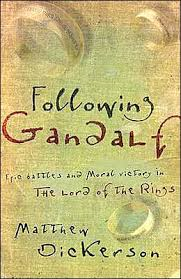
Following Gandalf
"For countless people, 'The Lord of the Rings' has provided splendid refreshment. For that, the author would be glad. But his deeper desire is that for some it would be an introduction to the mountains."
- Following Gandalf
I've had people tell me that the books I read are too serious. That may be true. I read more than just books about books though!
But, nevertheless, you've caught me red-handed. This is a book about a book. Actually, about all of Tolkien's books.
'Following Gandalf' by Matthew Dickerson is study of several aspects of Tolkien's philosophy and theology that can be deduced from his writings. Mr. Dickerson begins his book by debunking the view that the Lord of the Rings glorifies war. While I agree with his conclusions drawn from LotR and Tolkien's own letters that the Lord of the Rings does NOT glorify war, I wish he had also written a little about how while Tolkien doesn't glorify war, he does show how one's part in war can be noble, as Peter Kreeft does in 'The Philosophy of J.R.R. Tolkien'. I'm not going to get into that here though. The book also touches on the deeper war in Tolkien's Middle Earth books, namely, the spiritual war.
Dickerson also writes about Freedom (or free-doom as he calls it sometimes), the true power of the Ring (being the domination of wills), stewardship, hope and despair, salvation in its manifestations in LotR, and 'fate' vs. the guiding purpose of an all-powerful being, in the case of Middle Earth, Iluvatar.
Dickerson ends by asking and answering the question, "Is The Lord of the Rings a Christian Myth?" with an ambiguous 'yes and no'. I'm not going to give the reasons here though, this is a review of the book, not a lecture on it.
The book was very well written and clear, and easy to understand. I really liked how Mr. Dickerson had a quote from Tolkien's letters or books to support everything he said.
I really enjoyed reading this book, and I gained a deeper insight into LotR and the rest of Tolkien's writings by reading it.
Now, there are books about books that are fun (like this one) and books about books that are not (I here must mention 'The Philosophy of J.R.R. Tolkien', which while an interesting read, wasn't 'fun' in the common sense of the word). I definitely recommend this book to any Tolkien fan, even if they don't like philosophy or books about books ;)
Oh, and by the way, the quote at the beginning of this post contains the last words of the book. I thought it was a neat reference to 'A Leaf by Niggle', and a fitting way to end the book.
~~~~~~~~~~~~~~
Here I must attempt to apologize again. I missed yet another week of Stocking Update :P I make a solemn promise to post one on Saturday, even at the cost of my life and/or sanity. And possibly my Chemistry test score. Do I really have to memorize half the periodic table for a good grade?
- Following Gandalf
I've had people tell me that the books I read are too serious. That may be true. I read more than just books about books though!
But, nevertheless, you've caught me red-handed. This is a book about a book. Actually, about all of Tolkien's books.'Following Gandalf' by Matthew Dickerson is study of several aspects of Tolkien's philosophy and theology that can be deduced from his writings. Mr. Dickerson begins his book by debunking the view that the Lord of the Rings glorifies war. While I agree with his conclusions drawn from LotR and Tolkien's own letters that the Lord of the Rings does NOT glorify war, I wish he had also written a little about how while Tolkien doesn't glorify war, he does show how one's part in war can be noble, as Peter Kreeft does in 'The Philosophy of J.R.R. Tolkien'. I'm not going to get into that here though. The book also touches on the deeper war in Tolkien's Middle Earth books, namely, the spiritual war.
Dickerson also writes about Freedom (or free-doom as he calls it sometimes), the true power of the Ring (being the domination of wills), stewardship, hope and despair, salvation in its manifestations in LotR, and 'fate' vs. the guiding purpose of an all-powerful being, in the case of Middle Earth, Iluvatar.
Dickerson ends by asking and answering the question, "Is The Lord of the Rings a Christian Myth?" with an ambiguous 'yes and no'. I'm not going to give the reasons here though, this is a review of the book, not a lecture on it.
The book was very well written and clear, and easy to understand. I really liked how Mr. Dickerson had a quote from Tolkien's letters or books to support everything he said.
I really enjoyed reading this book, and I gained a deeper insight into LotR and the rest of Tolkien's writings by reading it.
Now, there are books about books that are fun (like this one) and books about books that are not (I here must mention 'The Philosophy of J.R.R. Tolkien', which while an interesting read, wasn't 'fun' in the common sense of the word). I definitely recommend this book to any Tolkien fan, even if they don't like philosophy or books about books ;)
Oh, and by the way, the quote at the beginning of this post contains the last words of the book. I thought it was a neat reference to 'A Leaf by Niggle', and a fitting way to end the book.
~~~~~~~~~~~~~~
Here I must attempt to apologize again. I missed yet another week of Stocking Update :P I make a solemn promise to post one on Saturday, even at the cost of my life and/or sanity. And possibly my Chemistry test score. Do I really have to memorize half the periodic table for a good grade?
Subscribe to:
Posts (Atom)